Amy's reunion with Baby
Other PeopleAmy Hide’s reunion with Baby converts an absence understood as death into a physical embrace, while leaving the central uncertainty of Amy’s identity unresolved. Baby believed Amy was dead; Amy is alive, but cannot yet remember her former life with certainty. The sisters meet again in a scene where recognition is immediate, memory is not, and the promise that the past may return remains just that—a promise.
Approach and emotional prelude
Just before the reunion, Amy examines an old execution photograph: seven men stand on a raised platform, among them a hooded figure holding a noose and the condemned-looking man whose stare meets the camera. Amy looks into the murderer’s eyes and thinks of him as a bored idiot. When she notices two words written on the back, she finds that Prince wrote, “You wait.” The note saddens her, though she cannot explain why. This unsettled pause precedes the doorbell and gives the meeting a charged context: waiting has been named, but what Amy is waiting for remains beyond her grasp.
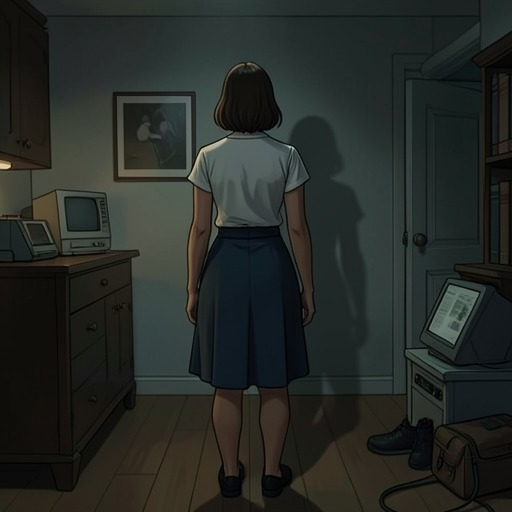
Amy walks dazedly into the hall and sees a shape behind the rippled glass. This time she decides not to hesitate. She opens the door, and her heart seems to be everywhere at once before she and Baby embrace. The account moves from a brief, uncertain recognition at the glass to an immediate bodily reunion. Amy does not first recover a memory or establish the visitor’s identity through explanation; the embrace arrives before either woman can make the past coherent.
Reunion and family recognition
A few minutes later, Baby says she cannot believe the meeting and remarks that Amy looks very young, even younger than she does. Amy rejects the comparison. Baby then says that she thought Amy was dead. Amy asks her not to say so, because the words make her feel she will “start again.” The exchange puts the reunion’s emotional reversal into plain terms: the person Baby had grieved as lost is before her, yet speaking of that supposed death threatens to overwhelm the moment of return.
Baby’s questions quickly turn from astonishment to the missing history. She asks what happened and whether Amy knows now. Amy answers that she still cannot remember anything for certain. The reunion therefore confirms presence, not explanation. Baby can see that Amy is alive and different, but neither sister can use the meeting to supply a settled account of Amy’s disappearance or the years between them.
Baby describes Amy’s former manner as awful, specifying a sullen, challenging, bored look. The remembered expression gives the change a visible shape: Baby is not simply welcoming the same person back after an absence, but comparing the young-looking woman before her with a sister whose former bearing she disliked. Her observation is intimate rather than abstract, grounded in a face and the impression it made. Amy does not answer this judgment by demonstrating that the old self has returned; the exchange leaves the difference acknowledged and unexplained.
What the sisters can and cannot recover
Amy asks after their father. Baby says that he is all right, though now completely blind, and that Marge and George are wonderful. She has not told them about Amy, an omission she and Amy both leave deliberately unspecified. Amy agrees that this is best. The brief exchange reconnects Amy to a family beyond the two women at the door, but it also shows that the reunion has not yet become news shared with the rest of that family. Their agreement sets a limit around what can be disclosed, without explaining the matter they are withholding.
The sisters also speak about Baby’s marriage and her daughter. Baby describes being married as fine, but inevitable, the next thing after leaving home, something one eventually has to do. Her daughter is called Mary, not Amy; Baby says she would call the next one Amy if it were a girl. Amy calls the choice strange, and Baby replies that Mary is a very common name. This small naming exchange places the sisters’ reunion beside the continuing life Baby has built, including a child whose name does not reproduce Amy’s. The possibility of a future daughter named Amy is a conditional gesture toward the absent sister, not a claim that the lost years can be undone.
Departure and significance
Near the end of their meeting, the sisters exchange lines of mutual love. Baby then returns to the image that has followed the encounter, telling Amy, “You wait,” and saying that everything will come back to her in time. The reassurance echoes Prince’s earlier inscription, but its meaning here is spoken between sisters: Baby offers a future in which memory might return, even though Amy has just admitted that nothing is certain. The repetition links the private note to the reunion without making it a solution to Amy’s amnesia.
The car pulls away, and Amy watches it disappear into the evening haze. The reunion ends with separation again, but now the departure follows an embrace and a direct exchange between the sisters. To steady herself, and to see whether she can be of any help there, Amy goes next door and spends two hours with Mr and Mrs Smythe. Their tea and cake, and Mrs Smythe’s familiar talk about her sons, return Amy to a neighboring household and its ordinary conversation. That domestic aftermath does not resolve what she cannot remember. Instead, it leaves the reunion as both a real restoration of kinship and an incomplete return: Baby has found Amy alive, while Amy must still wait for the past to become hers again.